
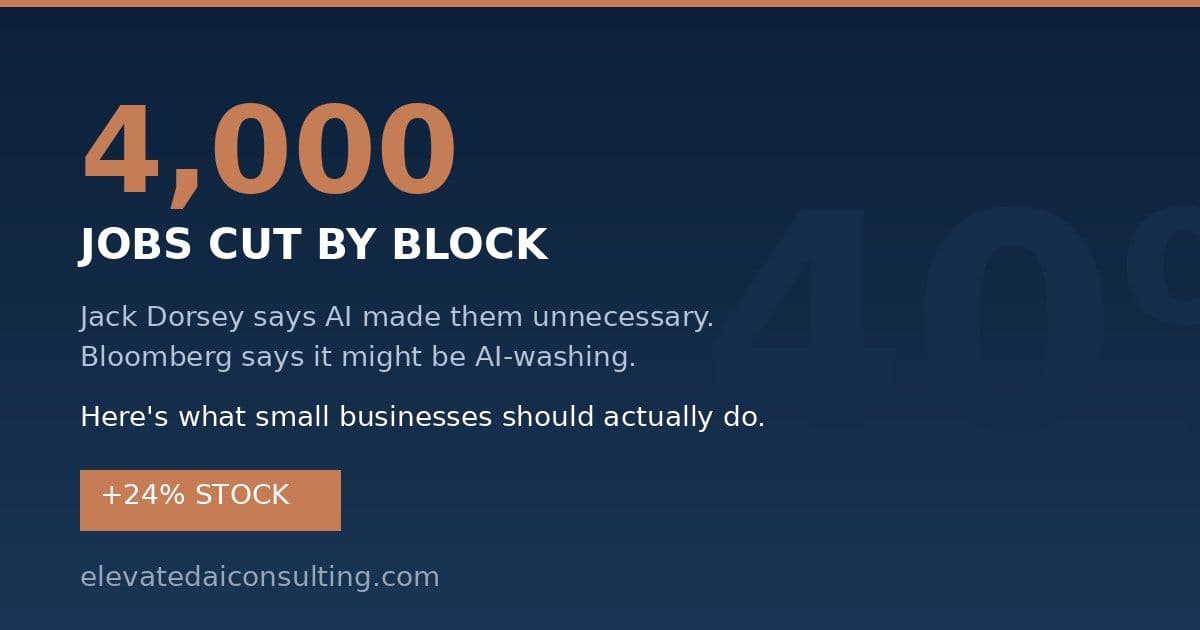
Last week, Jack Dorsey cut 4,000 people from Block — nearly half the company. His explanation? AI tools have made smaller teams more productive. His prediction? Most companies will do the same thing within a year.
Wall Street loved it. Block's stock jumped 24% in a single day.
If you run a small business and that headline made your stomach drop, you're not alone. But before you start panicking about robots replacing your team — or rushing to fire half your staff — the real story is more nuanced than the headlines suggest. And the smartest move for most businesses looks nothing like what Block did.
What Actually Happened at Block
Block — the company behind Square, Cash App, and Afterpay — went from 3,835 employees in 2019 to over 10,000 by 2025. Then Dorsey announced the company would slash back to under 6,000, citing “intelligence tools” that let smaller teams outperform larger ones.
In his letter to shareholders, Dorsey wrote that AI capabilities are “compounding faster every week” and that he'd rather make the cut proactively than be “forced into it reactively.”
Block's CFO Amrita Ahuja backed it up, saying the company is “choosing to shift how we operate at a time when our business is accelerating.” Translation: this wasn't a desperation move. Gross profit is growing. They're cutting because they believe they can do more with less.
The market agreed. A 24% stock surge in one day is Wall Street saying: we want companies to run leaner with AI.
AI-Washing or the Real Deal?
Here's where it gets interesting. Bloomberg ran a piece questioning whether Block's layoffs are genuine AI-driven restructuring — or “AI-washing” of pandemic-era overhiring.
The skepticism isn't unfounded. Block tripled its headcount between 2019 and 2025. An Oxford Economics report found that many layoffs CEOs attributed to AI were actually corrections from years of aggressive hiring when money was cheap and growth-at-all-costs was the playbook.
The truth is probably somewhere in the middle. Yes, AI tools genuinely make some roles more efficient. And yes, Block probably hired more people than it needed during the ZIRP era. Calling it all “AI transformation” makes the narrative cleaner and the stock price happier.
This matters for you because the takeaway from this story depends entirely on which version you believe. If you take Dorsey at face value, the conclusion is “fire half your team and replace them with AI.” If you look at the full picture, the conclusion is very different.
The Wrong Lesson Most People Are Taking
We've already seen the hot takes on LinkedIn: “AI is coming for your job,” “adapt or die,” “the robots are winning.” The fear sells. It gets engagement. But it misses what's actually happening on the ground.
Here's what we see working with businesses every week: the companies getting the most value from AI aren't firing people. They're making their existing teams faster.
The data backs this up. McKinsey found that professionals using AI tools become roughly 26% more productive within weeks. Deloitte reports that 88% of companies using AI agents are already seeing positive ROI — and the top performers are the ones investing in upskilling, not downsizing.
Block can afford to cut 4,000 jobs because Block is a $40 billion fintech company with deep engineering resources and proprietary AI tools. A 15-person accounting firm or a 50-person home services company? Completely different equation.
For most small and mid-size businesses, the right AI strategy isn't replacement. It's augmentation — giving your people better tools so they can handle more work, serve more customers, and spend less time on tasks that don't need a human brain.
The Augmentation Playbook: What Smart Businesses Do Instead
We've helped dozens of businesses adopt AI, and the pattern that works is consistent. It's not dramatic. It's not a “transformation.” It's a series of small automation wins that compound over time.
Step 1: Find the time sinks
Every business has tasks that eat up hours but don't require much judgment. Writing follow-up emails. Scheduling appointments. Answering the same customer questions. Formatting reports. Data entry.
Before you touch any AI tool, list every task your team does in a week and mark the ones that are repetitive, templated, or low-judgment. That's your automation target list.
Step 2: Automate the low-hanging fruit
Start with one or two tasks that are clearly automatable. An AI chatbot on your website that handles after-hours inquiries. An AI writing assistant that drafts your email responses. A scheduling tool that eliminates the back-and-forth.
These aren't moonshot projects. They're tools you can set up in a day and start seeing results within a week.
Step 3: Upskill your team
This is where most businesses drop the ball. They buy AI tools but never teach their team how to use them effectively. The result: the tools sit unused and the subscription gets cancelled after three months.
The World Economic Forum projects that 59% of the global workforce will need reskilling by 2030. Companies that invest in AI training now are building a competitive advantage that compounds — skills in AI-exposed roles are evolving 66% faster than other positions.
We wrote a full guide on this: how to upskill your team on AI in 30 days. The short version? Start with one tool, one workflow, one person. Get a win. Then expand.
Step 4: Measure and expand
Track what changes. If your admin assistant used to spend 3 hours a day on email and now spends 1 hour because AI handles the first draft — that's 2 hours per day you can redirect to higher-value work. That's 10 hours a week. 520 hours a year.
Those numbers add up fast, and they make the case for expanding AI to the next workflow.
Where AI Actually Saves Time Right Now
Based on what we're seeing with clients and the tools available in 2026, here's where AI delivers the most immediate value for small businesses:
- Customer communication: AI chatbots handle 70-80% of routine inquiries. After-hours leads get instant responses instead of waiting until morning. We covered the setup in our website chatbot guide.
- Email and writing: First drafts of emails, proposals, reports, and social posts take minutes instead of hours. Claude and ChatGPT both handle this well — the key is teaching your team which tool fits which task.
- Scheduling and admin: AI assistants can manage calendars, send reminders, and handle the back-and-forth that eats up an hour or more every day.
- Data analysis: Monthly reports that used to take a full day can be generated in 15 minutes when AI handles the formatting, calculations, and initial insights. Your team focuses on interpretation and decisions.
- Content and marketing: Blog posts, social media, email newsletters — AI accelerates all of it. Not by replacing your voice, but by handling the first draft so you can focus on editing and strategy.
The common thread: AI handles the grunt work. Humans handle the judgment, relationships, and creativity. That's augmentation, and it works.
How to Start Without Firing Anyone
Here's the practical path we recommend to every business that asks us about AI after reading headlines like Block's:
Week 1: Pick one workflow. Choose the most repetitive, time-consuming task your team handles. Email responses, customer FAQs, appointment scheduling — whatever takes the most hours for the least strategic value.
Week 2: Test an AI tool on it. Don't buy an enterprise platform. Start with a $20/month subscription to Claude or ChatGPT. Have one team member use it for that specific workflow and track the time difference.
Week 3: Train the team. Once you have a win, teach everyone else. Show them the prompts that work. Share the before-and-after time savings. Make it concrete and specific to their daily tasks.
Week 4: Measure and decide. How many hours did you save? What's the quality difference? Was anything lost? Use real data to decide whether to expand to the next workflow or adjust your approach.
This isn't a 6-month digital transformation project. It's a 30-day experiment that costs almost nothing and gives you real data to make decisions with.
If you've been watching headlines like Block's and wondering what to do, start here. The businesses that pull ahead in 2026 won't be the ones that panic-fire their teams. They'll be the ones that quietly gave their people better tools and watched the compound effect take hold.
We help businesses figure out where AI fits and how to roll it out without the chaos. If you want a structured plan for your specific situation, our AI Strategy Session ($149) covers exactly that — or check out our AI productivity training for teams that want to go deeper.

Elevated AI Consulting
Sam Irizarry is the founder of Elevated AI Consulting, helping businesses grow through strategic marketing and AI-powered solutions. With 12+ years of experience, Sam specializes in local SEO, web design, AI integration, and marketing strategy.
Learn more about us →