
Lovable just crossed $400 million in annual recurring revenue. With 146 employees. In February 2026 alone, they added $100 million in new revenue. Those aren't typos.
If you haven't heard of Lovable yet, it's the poster child of a movement called “vibe coding” — a term Andrej Karpathy (OpenAI co-founder) coined in early 2025 for the idea that you describe what you want in plain English and AI writes the code. Collins English Dictionary named it Word of the Year 2025. It's that big.
We've been watching Lovable closely because our clients keep asking about it. Some have tried it themselves. A few have come to us after trying it. So we decided to give it an honest review — what it does well, where it breaks, and when you should use it vs. when you need something more.
What Lovable Actually Is
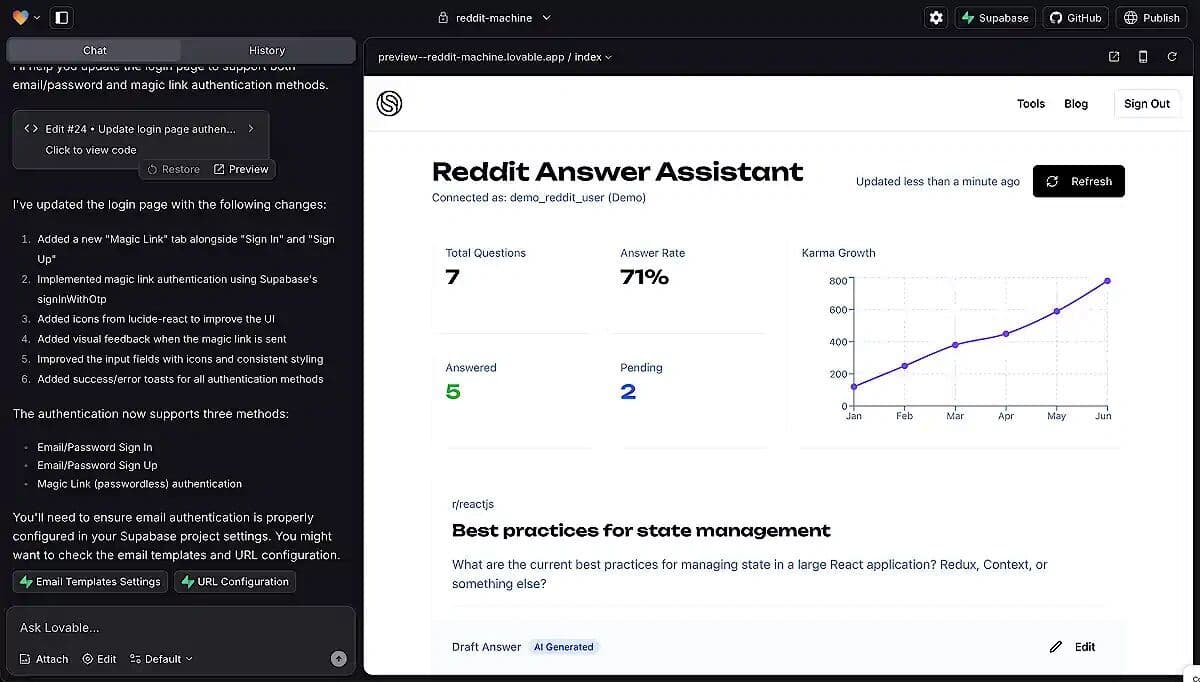
Lovable (lovable.dev) is an AI-powered app builder that turns plain English prompts into working web applications. You type something like “Build me a customer portal where clients can upload documents and track project status” and Lovable generates a complete application — frontend, backend, database, authentication, and deployment — all from that one sentence.
Under the hood, it uses Claude (Anthropic's AI model) to interpret your prompts and generate React + TypeScript + Tailwind CSS code, with Supabase handling the backend (database, auth, file storage). You get a live preview in your browser, iterate by chatting with the AI, and deploy with one click.
The company started life as “GPT Engineer” — an open-source project built by Anton Osika in Stockholm in 2023. A commercial version launched in late 2023 and flopped twice. They rebranded to Lovable in November 2024, added native Supabase integration, and growth exploded. The lesson: same product, better positioning, right timing.
What You Can Build (And It's Impressive)
Credit where it's due — Lovable can do a lot right out of the box:
- Full-stack web apps. Not just landing pages. Working applications with user accounts, databases, file uploads, and payment processing (via Stripe integration).
- Database and auth. Native Supabase integration means you get a real PostgreSQL database, user authentication (email, Google, GitHub login), and row-level security policies generated automatically.
- One-click deployment. Your app goes live on a lovable.app subdomain or your own custom domain. No server configuration, no DevOps.
- GitHub sync. Two-way sync means changes in Lovable push to GitHub, and code pushed to GitHub reflects back in Lovable. You own your code.
- Visual editing. A point-and-click editor for UI tweaks, plus Figma import via a Builder.io plugin. Mobile-responsive layouts are generated by default.
- Agent Mode. An autonomous AI mode that explores your codebase, debugs proactively, and searches the web for solutions when it gets stuck.
Real people are building real things with it. A growth marketer named Sabrine Matos (no engineering degree) built Plinq, a women's safety app — 10,000 users in three months, $456K ARR. Solo developers report tripling their client revenue by using Lovable to ship faster.
For internal tools, dashboards, MVPs, and idea validation, it's genuinely fast. You can go from “I have an idea” to “I have a working prototype” in an afternoon.
The $400M ARR Number in Context
Lovable's growth numbers tell a bigger story about where software is heading:
- $100M ARR in July 2025
- $200M ARR in November 2025 (doubled in 4 months)
- $300M ARR in January 2026
- $400M ARR in February 2026 ($100M added in one month)
That's $2.74 million in ARR per employee. For comparison, most SaaS companies at that scale have 500-1,000 employees. Lovable has 146.
They've raised $653 million across four rounds, with investors including CapitalG (Google), NVentures (Nvidia), Salesforce Ventures, Khosla Ventures, and Atlassian Ventures. The latest round in December 2025 valued them at $6.6 billion.
The same week TechCrunch reported Lovable's numbers, Replit announced a $9 billion valuation after raising $400 million. These aren't niche developer tools anymore. The market is saying: AI that builds software is a category worth tens of billions.
As we wrote about recently, one non-technical person running an entire function with AI is becoming the norm. Lovable is part of that same wave. The question isn't whether these tools will get adopted. It's whether they're ready for your use case right now.
Where Lovable Falls Apart
Here's where the honest part of this honest review comes in. We've seen enough AI-built projects to know the pattern: the first 80% feels like magic, then reality sets in.
SEO Is Fundamentally Broken
This is the biggest problem nobody talks about. Lovable generates pure client-side rendered (CSR) React single-page applications. That means when Google crawls your site, it sees an empty HTML shell. Your actual content loads after JavaScript executes — and search engines don't always wait around for that.
Production data shows Lovable CSR sites rank 30-50% lower than equivalent server-side rendered sites. Time to get indexed: 3-4 weeks vs. 1-2 weeks for SSR. Core Web Vitals scores: 60-70 vs. 85-95 for optimized SSR.
If you're building an internal tool or a logged-in app, this doesn't matter. If you're building a marketing website that needs to rank on Google — and with 40%+ of searches now happening via AI tools, that includes AI search engines too — this is a dealbreaker.
The Looping Problem
This is the single most common complaint from Lovable users. The AI tries to fix a bug, introduces a new one, tries to fix that, and re-introduces the original bug. Meanwhile, you're burning paid credits on every iteration.
Users report burning 60-150 credits on layout issues and AI-created bugs. At $25/month for 100 credits on the Pro plan, that adds up fast. The credit system means you're paying for the AI's mistakes on top of your own requests.
Complex Business Logic Fails
Lovable handles CRUD apps (create, read, update, delete) well. But multi-step workflows, non-trivial calculations, custom integrations, and anything with conditional business rules — it struggles. One reviewer built a bill-splitting app and the “Settle” button had incorrect math. That's the kind of bug that costs you customers.
Generic Design
The AI produces clean, safe layouts. But they all look the same. If your brand has specific design requirements, custom illustrations, unique interactions, or anything beyond a standard template — you'll hit a wall. Every Lovable site has a “Lovable site” look.
The 70% Problem
This is the pattern we see with every client who's tried Lovable: it gets you about 70% of the way to a finished product. That last 30% — production-grade security, custom design polish, SEO optimization, complex integrations, performance tuning — is where the real work lives. And it's where the code Lovable generated becomes hard to modify, because it wasn't written by someone who understood the overall architecture.
Lovable vs. the Alternatives
Lovable isn't the only tool in this space. Here's how it compares:
- Bolt.new — Similar concept but supports multiple frameworks (Vue, Svelte, not just React). Better for hackathons and quick prototypes. Around $20/month.
- Replit — Full development environment with AI built in. Just hit $9B valuation. More powerful but also more complex. Better for people who want to understand and modify the code. ~$25/month.
- v0 by Vercel — Focused on UI components, not full apps. Great for generating React + Tailwind + shadcn/ui components that you drop into an existing project. $20/month.
- Cursor — AI-native IDE for professional developers. Brings your own stack, deep codebase awareness. Requires coding knowledge. $20/month.
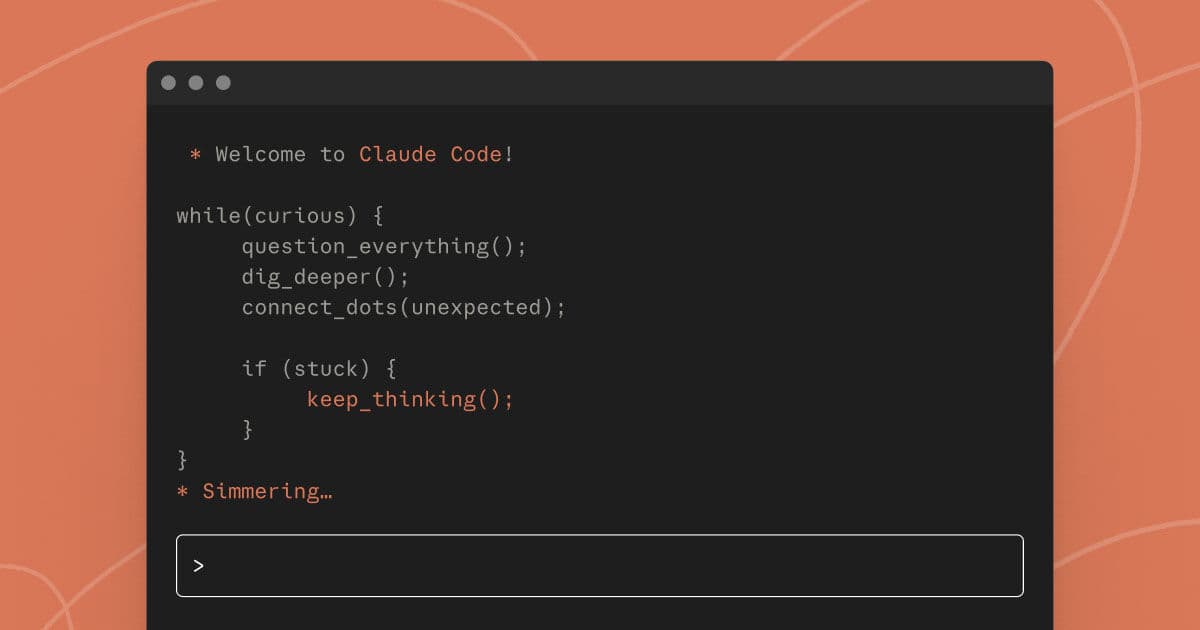
- Claude Code — Terminal-based AI development tool. Deep reasoning, full codebase analysis, production-grade output. What we use to build client projects. Requires technical expertise.
The key distinction: Lovable is an “idea-to-app machine” for non-coders. Cursor and Claude Code are supercharged developer tools that require technical expertise. Many teams actually use both — non-technical members prototype in Lovable, developers refine in Cursor or Claude Code, connected via GitHub.
One detail worth knowing: Lovable uses Claude under the hood to generate its code. So when you're using Lovable, you're already using Anthropic's AI — just with guardrails and a visual wrapper around it.
When Lovable Makes Sense (And When It Doesn't)
Use Lovable when:
- You have a business idea and want to validate it before investing in a real build
- You need an internal tool (dashboard, tracker, portal) that doesn't need to rank on Google
- You're a non-technical founder who needs a working demo for investors or early users
- Speed matters more than polish — you need something live this week, not this quarter
- You're building a side project or personal tool
Don't use Lovable when:
- SEO matters — if you need to rank on Google or appear in AI search results, Lovable's client-side rendering is a non-starter
- Your business depends on features like AI chatbots, custom integrations, or complex workflows
- You're handling sensitive data, payments at scale, or anything in a regulated industry
- Design is a differentiator for your brand — Lovable produces generic, template-level design
- You need long-term maintainability — AI-generated code without architectural intent becomes tech debt fast
The Smart Play: Prototype Fast, Build Right
Here's what we actually recommend to clients who ask about Lovable:
Use it for Phase 1. Build your prototype in Lovable. Test the idea. Show it to customers. Get feedback. Figure out what features actually matter vs. what you assumed would matter. This phase should cost you $25-50 and a weekend.
Then build the real thing properly for Phase 2. Once you know what you're building, invest in a production-grade version with proper SEO, security, performance, and a design that actually represents your brand. The Lovable prototype isn't wasted — it's your spec doc. You've already figured out the user flows and feature priorities.
As we mentioned on X recently: “vibecoding lets you ship fast. the mental model you build along the way is the real product.” That mental model — knowing exactly what your app needs to do — is worth more than the prototype code itself.
The businesses getting the most out of AI tools right now aren't the ones going all-in on one tool. They're the ones using the right tool for each phase. Lovable for speed. Professional development for production. That combination is faster and cheaper than either approach alone.
If you've built a Lovable prototype and you're ready for the production version — or if you want to skip straight to a build that's designed to rank, convert, and scale — we should talk.

Elevated AI Consulting
Sam Irizarry is the founder of Elevated AI Consulting, helping businesses grow through strategic marketing and AI-powered solutions. With 12+ years of experience, Sam specializes in local SEO, web design, AI integration, and marketing strategy.
Learn more about us →